
Content Marketing Funnel Explained: A Complete Guide for 2026
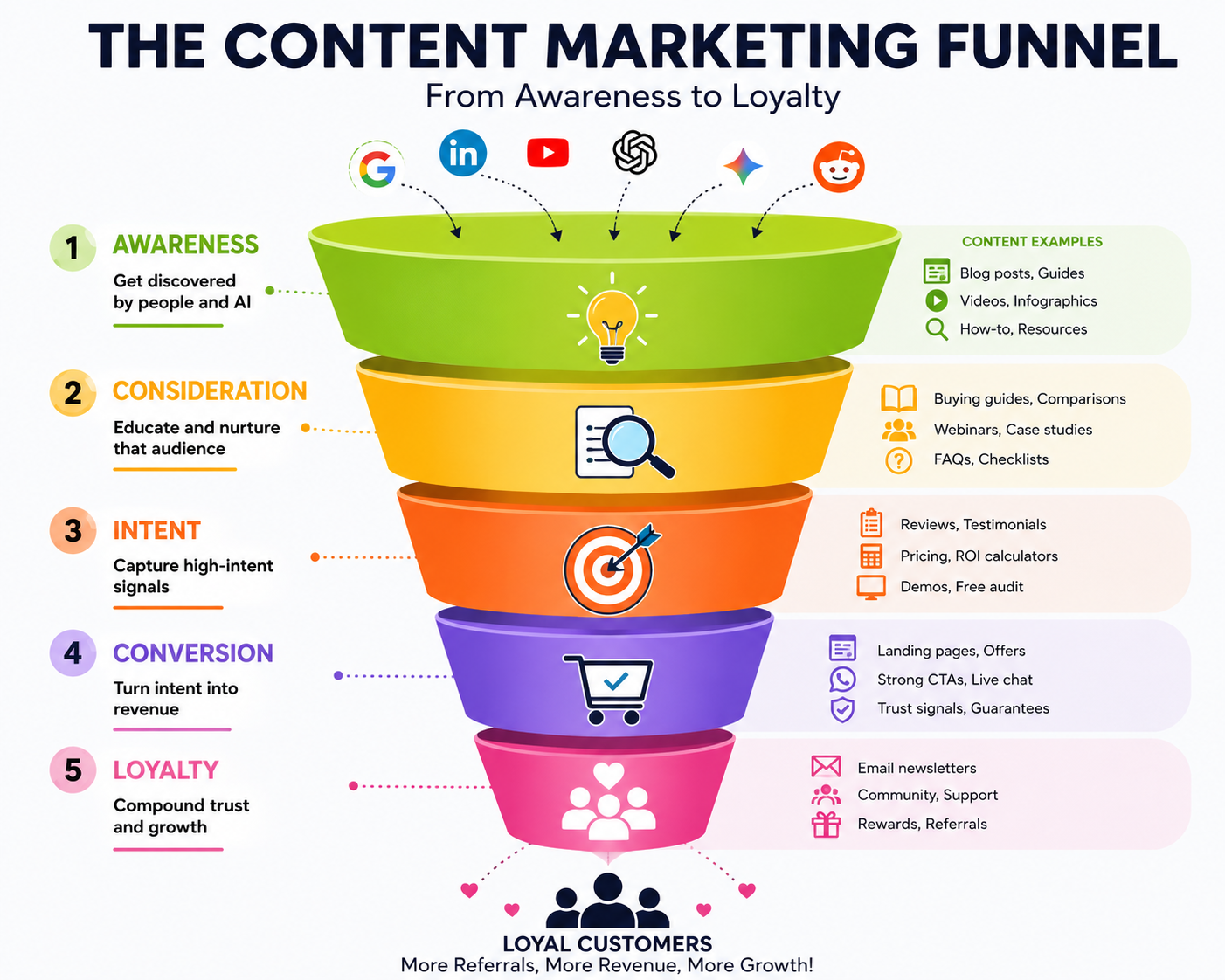
A successful content marketing funnel does more than bring visitors to a website. It guides people from their first interaction with a brand to enquiry, purchase, repeat business and referral.
In 2026, this journey no longer happens only through Google Search. Potential customers may discover a business through social media, YouTube, Reddit, Google AI Overviews, ChatGPT, Perplexity, email newsletters or online communities before visiting the company website.
This means businesses need a structured content marketing strategy for every stage of the customer journey.
What Is a Content Marketing Funnel?
A content marketing funnel is a framework that uses different types of content to move potential customers through the buying journey.
The five main stages are:
- Awareness - Help people discover the brand.
- Consideration - Educate people while they compare solutions.
- Intent - Capture signals from people preparing to buy.
- Conversion - Turn interested prospects into customers.
- Loyalty - Retain customers and encourage repeat business.
The first three stages are also commonly described as:
- TOFU - Top of Funnel
- MOFU - Middle of Funnel
- BOFU - Bottom of Funnel
Why the Content Marketing Funnel Matters
Most customers do not buy immediately after discovering a business.
They search, compare, read reviews, watch videos, study pricing, check competitors and return several times before making a decision. A well-planned content funnel supports the customer throughout this process.
Without a funnel, businesses often make one of two mistakes:
- They publish general content that attracts traffic but generates few enquiries.
- They publish only sales content and fail to attract people who are still researching.
A proper funnel connects traffic generation, customer education, lead generation, conversion optimisation and customer retention.
1. Awareness Stage: Attract the Right Audience
The awareness stage sits at the top of the content marketing funnel. At this point, people may not know the business or fully understand their problem.
The objective is to become visible when potential customers search for information.
Best Content for the Awareness Stage
- SEO blog posts
- Beginner guides
- Educational videos
- Industry reports
- Infographics
- LinkedIn posts
- YouTube videos
- Podcasts
- Original research
- Expert commentary
Typical Awareness Keywords
- What is content marketing?
- How does SEO work?
- How to increase website traffic
- Digital marketing tips
- How to generate leads online
- Content marketing examples
Awareness Stage KPIs
- Organic traffic
- Search impressions
- Keyword rankings
- Social media reach
- Video views
- Brand mentions
- AI citations and mentions
Awareness content should educate rather than aggressively sell. The aim is to earn attention and establish expertise.
2. Consideration Stage: Educate and Nurture Prospects
During the consideration stage, people understand their problem and begin comparing possible solutions.
This is where useful, detailed and trustworthy content becomes critical.
Best Content for the Consideration Stage
- Comparison articles
- Buying guides
- Detailed tutorials
- Case studies
- Webinars
- White papers
- Checklists
- Email courses
- Product demonstrations
- Frequently asked questions
Typical Consideration Keywords
- SEO vs Google Ads
- Best content marketing tools
- WordPress vs Shopify
- Best digital marketing agency
- Content marketing services
- SEO agency comparison
Consideration Stage KPIs
- Time on page
- Returning visitors
- Email subscriptions
- Guide downloads
- Webinar registrations
- Product page visits
- Content engagement
The content must help prospects understand their options and make a sensible decision. Empty sales claims will not work here. Evidence, clarity and practical information matter.
3. Intent Stage: Capture High-Intent Signals
At the intent stage, the prospect is actively considering a purchase. They may be checking prices, reviews, features, availability or service providers.
This is the stage where commercial and transactional search keywords become important.
Best Content for the Intent Stage
- Pricing pages
- Service pages
- Customer reviews
- Testimonials
- Competitor comparison pages
- Return on investment calculators
- Product demos
- Free audits
- Consultation pages
- Detailed case studies
High-Intent Keywords
- SEO company near me
- Google Ads agency
- Content marketing agency
- SEO services pricing
- PPC management cost
- Hire a digital marketing consultant
- Best website development company
Intent Stage KPIs
- Pricing page visits
- Demo requests
- Quote requests
- Free audit requests
- Form starts
- WhatsApp enquiries
- Phone calls
Intent content should answer the questions that normally prevent a customer from taking the next step.
4. Conversion Stage: Turn Interest into Revenue
At the conversion stage, the prospect is ready to act. The job of the content is to make that action clear, easy and low-risk.
Best Content for the Conversion Stage
- Conversion-focused landing pages
- Product or service pages
- Checkout pages
- Free consultation offers
- Limited-time promotions
- Email follow-up sequences
- WhatsApp follow-ups
- Abandoned cart emails
- Guarantees and trust signals
Conversion Optimisation Best Practices
- Use a clear headline that matches the visitor's search intent.
- Explain the offer in simple language.
- Use one strong primary call to action.
- Keep enquiry forms short.
- Add genuine testimonials and proof.
- Show pricing where appropriate.
- Make the page mobile-friendly.
- Improve page loading speed.
- Offer direct contact through phone, email or WhatsApp.
Conversion Stage KPIs
- Conversion rate
- Cost per lead
- Cost per acquisition
- Revenue per lead
- Sales volume
- Return on ad spend
- Cart abandonment rate
More traffic cannot fix a weak conversion process. If the landing page is confusing, slow or unconvincing, additional traffic simply produces more wasted visits.
5. Loyalty Stage: Retain Customers and Build Advocacy
The customer journey should not end after the sale.
Retaining an existing customer is generally more efficient than repeatedly acquiring new customers. Loyal customers may also generate referrals, reviews and user-generated content.
Best Content for the Loyalty Stage
- Customer onboarding emails
- Product tutorials
- Helpful newsletters
- Product updates
- Customer communities
- Referral programmes
- Loyalty rewards
- Help centres
- Support documentation
- Customer success stories
Loyalty Stage KPIs
- Customer retention rate
- Repeat purchase rate
- Renewal rate
- Customer lifetime value
- Referral volume
- Review generation
- Churn rate
Loyalty content should continue delivering value instead of contacting customers only when the business wants another sale.
Content Marketing Funnel Examples
Example 1: SEO Agency
- Awareness: Blog post explaining why website traffic is falling.
- Consideration: Guide comparing SEO, Google Ads and social media advertising.
- Intent: SEO pricing page and client case studies.
- Conversion: Free SEO audit landing page.
- Loyalty: Monthly reports, strategy updates and educational emails.
Example 2: E-commerce Business
- Awareness: Product guides, videos and social media content.
- Consideration: Product comparisons and buying guides.
- Intent: Reviews, product specifications and pricing pages.
- Conversion: Product page, checkout and abandoned cart follow-up.
- Loyalty: Repeat purchase emails and personalised recommendations.
Example 3: Local Service Business
- Awareness: Local SEO articles answering common customer questions.
- Consideration: Service comparison pages and project examples.
- Intent: Pricing information, reviews and service area pages.
- Conversion: Call, WhatsApp or booking form.
- Loyalty: Service reminders, follow-ups and referral offers.
SEO and AI Search in the Modern Content Funnel
The modern content funnel must support both traditional search engines and AI-powered discovery platforms.
People increasingly research products and services through:
- Google Search
- Google AI Overviews
- ChatGPT
- Perplexity
- Gemini
- YouTube
- Online communities
This has increased the importance of Generative Engine Optimisation, also known as GEO, and AI search optimisation.
How to Make Content Easier for Search Engines and AI Systems to Understand
- Answer important questions directly.
- Use descriptive headings and subheadings.
- Include original data, examples and expert observations.
- Use clear definitions.
- Support claims with credible sources.
- Add structured data where relevant.
- Maintain consistent business information across the web.
- Update outdated content.
- Avoid thin, repetitive and generic AI-generated text.
Publishing large quantities of weak content is not a serious strategy. Search engines and users both need content that adds real value.
How to Build a Content Marketing Funnel
Step 1: Understand the Target Audience
Identify the audience's problems, questions, objections, priorities and buying behaviour.
Step 2: Conduct Keyword Research
Use keyword research tools such as Google Keyword Planner, Google Search Console, Semrush or Ahrefs to identify informational, commercial and transactional search terms.
Step 3: Map Keywords to Funnel Stages
Do not target every keyword using the same type of page.
- Informational keywords normally belong to awareness content.
- Comparison keywords normally belong to consideration content.
- Pricing and service keywords normally belong to intent content.
- Transactional keywords normally belong to conversion pages.
Step 4: Create Content for Each Stage
Build a balanced content plan instead of publishing only blog posts or only sales pages.
Step 5: Connect the Funnel with Internal Links
Each page should guide the visitor towards the next logical action.
For example:
- A beginner guide can link to a comparison article.
- A comparison article can link to a case study.
- A case study can link to a pricing or consultation page.
Step 6: Add Clear Calls to Action
The call to action should match the visitor's stage.
- Awareness: Read another guide.
- Consideration: Download a checklist.
- Intent: View pricing or request an audit.
- Conversion: Book, buy or contact.
- Loyalty: Refer a friend or renew the service.
Step 7: Measure and Improve
Use tools such as Google Analytics 4, Google Search Console, customer relationship management software and advertising platforms to identify where users leave the funnel.
Content Marketing Funnel Metrics
| Funnel Stage | Main Objective | Important Metrics |
|---|---|---|
| Awareness | Increase discovery | Impressions, traffic, reach and rankings |
| Consideration | Build trust | Engagement, returning visitors and downloads |
| Intent | Capture buying signals | Pricing visits, enquiries and demo requests |
| Conversion | Generate revenue | Conversion rate, sales, CPA and ROAS |
| Loyalty | Retain customers | Repeat purchases, renewals and referrals |
Common Content Funnel Mistakes
- Creating content without understanding search intent.
- Focusing only on traffic instead of qualified leads.
- Publishing only top-of-funnel articles.
- Sending all visitors to the homepage.
- Using weak or unclear calls to action.
- Ignoring mobile usability and page speed.
- Failing to connect content through internal links.
- Not measuring leads and revenue.
- Ignoring existing customers after conversion.
- Using generic AI content without expert input or original value.
Frequently Asked Questions
What are the stages of a content marketing funnel?
The main stages are awareness, consideration, intent, conversion and loyalty. The first three stages are often grouped as TOFU, MOFU and BOFU.
What is TOFU, MOFU and BOFU content?
TOFU means top-of-funnel content used for awareness. MOFU means middle-of-funnel content used for education and comparison. BOFU means bottom-of-funnel content designed to support purchase decisions and conversions.
What is the difference between a sales funnel and a content marketing funnel?
A sales funnel focuses mainly on the steps leading towards a sale. A content marketing funnel explains how content supports customers before, during and after the buying decision.
How do you measure a content marketing funnel?
Measurement depends on the stage. Awareness is measured using reach and traffic, consideration through engagement, intent through enquiries, conversion through sales, and loyalty through retention and referrals.
Does content marketing still work in 2026?
Yes, but generic content is becoming less effective. Businesses need useful, original, well-structured content that serves real customer needs and can be discovered through search engines, AI platforms, video platforms and online communities.
Final Thoughts
A content marketing funnel is not merely a diagram used in presentations. It is a practical system for attracting the right audience, building trust, capturing demand, increasing conversions and retaining customers.
The strongest content strategies do not treat every visitor in the same way. They understand that a person discovering a problem needs different information from someone comparing prices or preparing to buy.
Businesses that create useful content for every stage of the funnel are better positioned to generate qualified traffic, improve lead quality, reduce wasted marketing spend and build long-term customer relationships.